
Imagine a territory so vast and so difficult to conquer that even the Spanish Empire, with all its armies and missionaries, couldn't fully control it for three centuries. That territory exists. It's called La Guajira, it's in the far north of Colombia, and we've been exploring it for over ten years, starting from Riohacha. This is its story—and it's much wilder, more rebellious, and more fascinating than most travelers imagine.

It all started ten thousand years ago
Long before Colombia existed as a concept, long before a single European crossed the Atlantic, the Guajira plains were already inhabited. The first to arrive were peoples of the Arawak language family, some ten thousand years ago. Later came the Chibcha, who moved up into the highlands of the Sierra Nevada de Santa Marta. And still later, about two thousand years ago, the Caribs settled there.
What's interesting is that both the Arawaks and the Caribs displaced earlier inhabitants about whom almost nothing is known today. Entire peoples existed, lived, and disappeared, leaving no trace but silence in the archaeological record. It's one of those mysteries that still remains unsolved.
By the time history begins to take on clear names and dates, the map of the territory was already complex. In southern La Guajira, in the Sierra Nevada mountains, lived the Ika (Arhuaco), the Kankuamo, the Kogui, and the Wiwa. In the center were the Guanebucán and the Caquetío. And throughout the peninsula, from north to south, lived the Wayuu—who were then called Guajiros—along with the Cocina and the Makuira.
These were not isolated peoples. They traded with each other, shared territory, and lived together. Those in the north were organized into clans with chiefs; those in the center functioned as more structured nations. Over time, the smaller clans integrated into larger groups, and some simply ceased to exist as separate entities. But the diversity was enormous.
Today you can meet several of these peoples firsthand. The Wayuu remain the largest indigenous group in Colombia, and when you take a tour of the Upper Guajira With us, you sleep in rancherías with families we know personally. And if you want to understand the worldview of the Sierra Nevada, we have direct experiences with the Kogui community and the Arhuaca community of Seydukwa.
The "older brothers" and an invisible line that protects the world
The Chibcha peoples who settled in the Sierra Nevada have a surprising origin: they arrived from what is now Nicaragua, traveling across the continent alongside the Chimila and the Yukpa. Upon settling in the highlands of the Sierra, they defined themselves as older siblings — for living up high, closer to heaven — and they called younger siblings to all the peoples of the plains.
That distinction wasn't just a name. It was (and still is) a complete worldview. The Kogui, the Arhuaco, the Wiwa, and the Kankuamo believe they maintain the spiritual balance of the world from their mountains. This isn't a metaphor: for them, every ritual they perform in the Sierra maintains the order of all that exists.
Over time, these four peoples demarcated a shared sacred territory to which they added an invisible boundary: the Black Line, either Shi Mukshi in their language. Along that line they established ceremonial centers that are still sites of pilgrimage and offerings today. The Colombian State legally recognized the Black Line and protects the sacred sites that comprise it.
When you visit the Kogui in our tour to Mulkwakungui, They still present themselves as elder brothers. It's not arrogance or folklore: it's a living belief that is thousands of years old and continues to function as a system of governance and spirituality.
1499: Europeans arrive and believe that La Guajira is an island
The first time European eyes laid sight of the shores of La Guajira was in 1499. An expedition commanded by Juan de la Cosa, with Alonso de Ojeda and Martín Fernández de Enciso aboard, sailed the length of the peninsula. And they made a mistake that speaks volumes about their limited understanding of the territory: they thought it was an island. They called it Coquivacoa.
That name survives to this day. If you walk through Riohacha, Commune 9 is called Coquivacoa. History is written in the street names, even if most people don't know it.
Ojeda returned to Spain, convinced the Castilian monarchs to give him the governorship of those lands, and on May 3, 1502, he founded a small settlement called Santa Cruz, Located near the Castillete lagoon in the north of the peninsula, it was the first settlement of European colonists on the entire South American continent. Before any city in Brazil, Peru, or Argentina, there was a Spanish town in La Guajira.
It lasted three months.
The local economy depended on pearl diving, and the colonists forced the indigenous people to do the diving work. The native communities expelled them and destroyed the settlement. The kings dissolved the governorship in September of that same year. Three months was all that the first European attempt to dominate La Guajira lasted.
And that resistance would be repeated time and time again during the next three centuries.

Pearls, pearl divers and the true origin of Riohacha
In 1538, a group of Spanish pearl fishermen who had exhausted the pearl beds of Cubagua Island, in present-day Venezuela, appeared on the shores of Cabo de la Vela in search of new waters. The desert conditions were too harsh, so they traveled south until they found a settlement inhabited by Guanebucanes and Wayuu families at the mouth of a river.
They took possession of the place, and gave it a very long name — Our Lady Saint Mary of Remedies of the River Axe —and forced the indigenous inhabitants to dive for pearls. That people is what we know today as Riohacha.
There's an interesting historical debate behind this. The official version states that Riohacha was founded by the German Nicolás de Federmann in 1545. But scholars like Benjamín Ezpeleta and Marco Tulio Annicchiarico have been arguing for decades that this is impossible: Federmann died in 1542, three years before the date attributed to him. What is documented is that the pearl divers of Cubagua were already there by 1538 and that the settlement existed before the supposed founding.
Pearls were the first great wealth that Europeans extracted from La Guajira. Riohacha became a slave port, and along with the now-destroyed Puerto López in the north, it was the entry point for enslaved people brought from Africa for pearl work and for the gold mines of Dibulla.
Today you can visit the Cape of the Sail Exactly where those pearl divers landed. When you climb Sugarloaf Mountain at sunset and see that landscape where the desert meets the Caribbean, you're standing in the very place where this whole story began. Only now the desert is devoid of pearls, and the Wayuu are no longer anyone's slaves.
Three hundred years of colony, seven great rebellions
Spanish colonial rule in La Guajira officially extended from 1502 to 1820. But there is something fundamental that most historical accounts do not tell with the clarity it deserves: The Spanish never controlled the entire territory.
They dominated Riohacha, some southern towns, and part of the central region. But the entire Upper Guajira, the Sierra Nevada, and the Serranía del Perijá remained outside their jurisdiction. The Wayuu maintained their autonomy for over three hundred years. They were not conquered. Period.
During that time, towns were founded that still exist today: El Molino in 1595, Villanueva in 1662 (on a settlement of the cacique Canopan that already existed), Barrancas in 1664, San Juan del César in 1701. But many of these "foundations" were actually pre-existing indigenous villages whose names were changed by the Spanish and who were given a priest.
What truly defined the colonial period in La Guajira was not the founding of settlements but the rebellions. In the 18th century alone, there were seven major Wayuu uprisings. These were not spontaneous revolts of desperate people. The Wayuu were numerous, organized, had learned to use horses and European firearms, and traded with the Dutch, English, and French to obtain what they needed. They were a real military power that the Spanish could not underestimate.
The soldiers sent from Cartagena and Maracaibo were unable to contain the attacks that the Wayuu were launching throughout the central part of the territory. They were numerous, organized, and trained in the use of European equipment.
The most documented rebellion erupted on May 2, 1769. Twenty-two Wayuu people had been kidnapped by the Spanish authorities. The response was devastating: the Wayuu burned the town of El Rincón, killed a Capuchin priest and three Spaniards, and for weeks held the entire central region hostage. Rumors circulated that they planned to burn Riohacha. The colonial authorities requested reinforcements from Cartagena and Maracaibo, but the soldiers were overwhelmed.
The rebellion wasn't stopped by the Spanish army. It was stopped by an internal conflict: the corporal who died at El Rincón, José Antonio de Sierra, was of mixed race and had Indigenous family. His relatives decided to avenge his death according to traditional Wayuu law, and this internal conflict distracted the rebels long enough for the Spanish to counterattack with massacres against defenseless communities.
That pattern—indigenous resistance, colonial repression, massacres—repeated itself throughout the 18th century. And yet, the Wayuu were never subdued.
The revolutionaries of Martinique whom the Wayuu saved
There is an episode in the history of La Guajira that seems like something out of a novel and that almost nobody knows about.
In 1802, Napoleon Bonaparte decided to reinstate slavery in the French colonies of the Caribbean. On the island of Martinique, between 200 and 500 people of African descent who had led a revolution to abolish the slave system were captured by French troops. They were called black revolutionaries. But instead of executing or re-enslaving them, the French did something particularly cruel: they put them on ships and abandoned them on the shores of the Guajira Peninsula, without prior notice to anyone.
The idea was simple and macabre: they hoped the Wayuu would kill them.
The exact opposite happened. The Wayuu welcomed them.
This reception caused panic among the colonial authorities of Riohacha, Santa Marta, and Maracaibo. Viceroy Antonio José Amar y Borbón recorded his concern about a possible alliance between the former French slaves and the indigenous people, fearing that together they would attack Spanish estates and possessions. Of all the people abandoned on the coast, the provincial authorities only managed to capture one. They murdered her.
Meanwhile, in the central and southern parts of the territory, palenques like Matitas and La Ramada had existed for decades—communities of enslaved people who had escaped and built their own free towns. La Guajira was not only Wayuu territory: it was also a refuge for anyone fleeing colonial oppression.
La Guajira during Independence: looking towards the Caribbean, not Bogotá
When the Spanish monarchy entered into crisis between 1808 and 1814, the province of Hacha — as La Guajira was then called — made a decision that reveals much about its identity: instead of recognizing the authority of the Santa Fe (Bogotá) junta, it adhered to the Regency Junta of Cádiz and swore allegiance to King Ferdinand VII.
It wasn't blind loyalty to Spain. It was that La Guajira always felt more connected to the Caribbean than to the Andean interior. Its trade, its alliances, its people—everything looked to the sea, not the mountains.
On September 17, 1810, Governor Pedro Pérez established the Supreme Governing Junta of the province. When Ferdinand VII was restored to the throne, one of his first acts was to revoke the amnesty that had been granted to Wayuu merchants to trade legally in Riohacha. For two years they had enjoyed commercial recognition. It was taken away with a stroke of the pen, and everything reverted to being considered "contraband.".
That tension between the law imposed from outside and the reality of the territory continues to be, in many ways, the story of La Guajira.
A territory that was never conquered
If there's one thing that sums up ten thousand years of La Guajira's history, it's this: the territory was never completely conquered. The Spanish controlled some coastal points and southern settlements, but Upper Guajira remained under Wayuu rule throughout the colonial period, during the War of Independence, and in many ways, to this day.
That history of resistance isn't in a museum. It's alive. It's in the Wayuunaiki language you hear when you arrive in the desert. In the clan structure that continues to organize social life. In the wordsmith (pütchipü'üi) which resolves conflicts between families according to an oral law that is more than a millennium old and that UNESCO recognized as intangible cultural heritage of humanity. In the rancherías where families welcome you, they hang a hammock for you and tell you stories by the fire.
When you travel to La Guajira with us, you're not just going to another tourist destination. You're entering a territory with a five-hundred-year history of resistance, where Indigenous communities maintain their autonomy, their language, their justice system, and their way of life. That's what makes this experience unlike any other in Colombia.
Experience this story with your feet in the sand
The best way to understand the history of La Guajira is not to read it. It's to experience it. To sleep in a Wayuu hammock swayed by the trade winds, to climb Pilón de Azúcar at sunset and see the same horizon that Juan de la Cosa and Alonso de Ojeda saw in 1499, to walk the Taroa dunes that drop to the sea at Punta Gallinas — the northernmost point of all South America.
We've been operating from Riohacha for over ten years. We know the Wayuu families, the trails, the stories. Each of these tours connects you with what you've just read.
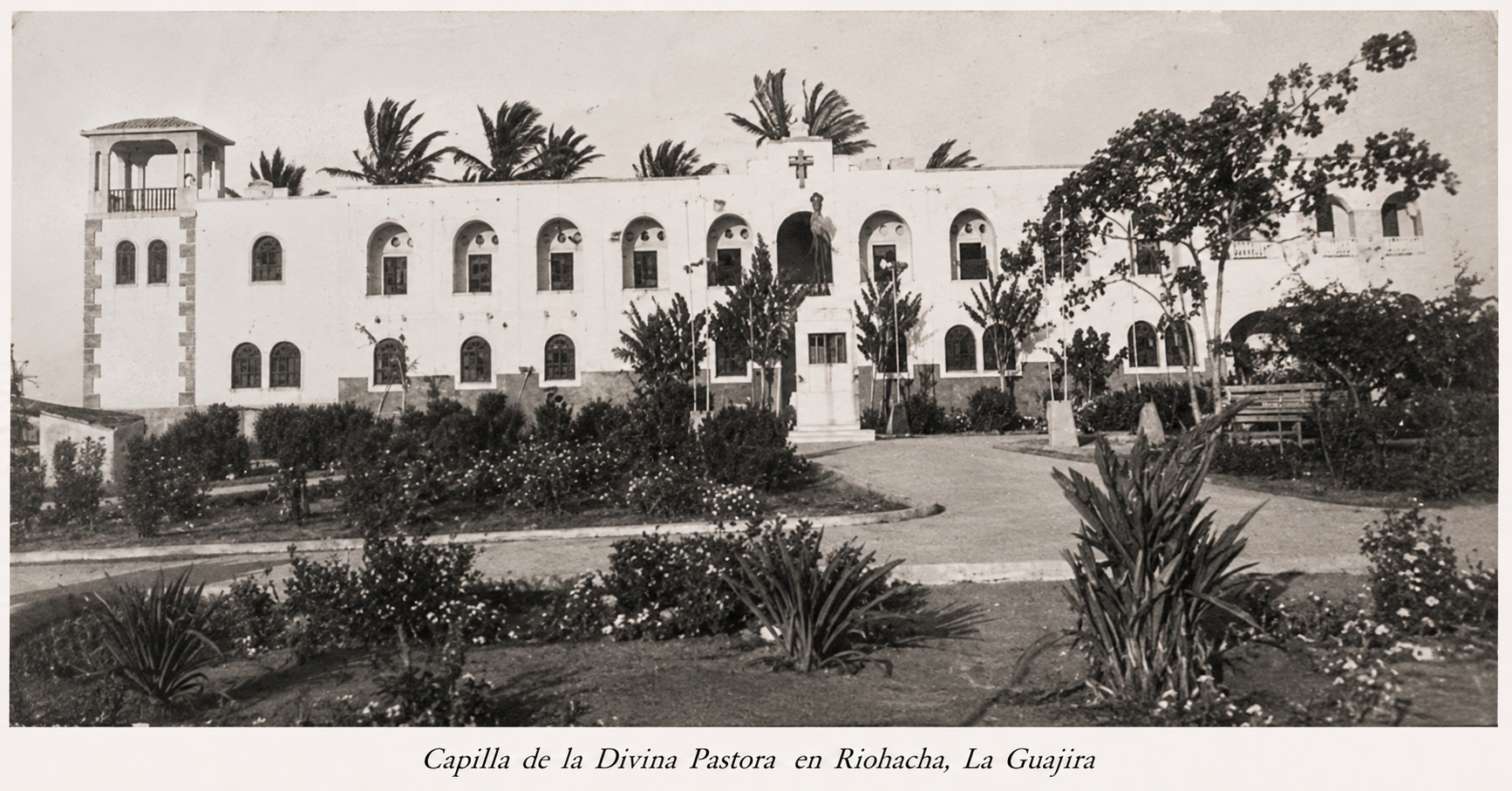
Imagine a territory so vast and so difficult to conquer that even the Spanish Empire, with all its armies and missionaries, couldn't fully control it for three centuries. That territory exists. It's called La Guajira, it's in the far north of Colombia, and we've been exploring it for over ten years, starting from Riohacha. This is its story—and it's much wilder, more rebellious, and more fascinating than most travelers imagine.
It all started ten thousand years ago
Long before Colombia existed as a concept, long before a single European crossed the Atlantic, the Guajira plains were already inhabited. The first to arrive were peoples of the Arawak language family, some ten thousand years ago. Later came the Chibcha, who moved up into the highlands of the Sierra Nevada de Santa Marta. And still later, about two thousand years ago, the Caribs settled there.
What's interesting is that both the Arawaks and the Caribs displaced earlier inhabitants about whom almost nothing is known today. Entire peoples existed, lived, and disappeared, leaving no trace but silence in the archaeological record. It's one of those mysteries that still remains unsolved.
By the time history begins to take on clear names and dates, the map of the territory was already complex. In southern La Guajira, in the Sierra Nevada mountains, lived the Ika (Arhuaco), the Kankuamo, the Kogui, and the Wiwa. In the center were the Guanebucán and the Caquetío. And throughout the peninsula, from north to south, lived the Wayuu—who were then called Guajiros—along with the Cocina and the Makuira.
These were not isolated peoples. They traded with each other, shared territory, and lived together. Those in the north were organized into clans with chiefs; those in the center functioned as more structured nations. Over time, the smaller clans integrated into larger groups, and some simply ceased to exist as separate entities. But the diversity was enormous.
Today you can meet several of these peoples firsthand. The Wayuu remain the largest indigenous group in Colombia, and when you take a tour of the Upper Guajira With us, you sleep in rancherías with families we know personally. And if you want to understand the worldview of the Sierra Nevada, we have direct experiences with the Kogui community and the Arhuaca community of Seydukwa.
The "older brothers" and an invisible line that protects the world
The Chibcha peoples who settled in the Sierra Nevada have a surprising origin: they arrived from what is now Nicaragua, traveling across the continent alongside the Chimila and the Yukpa. Upon settling in the highlands of the Sierra, they defined themselves as older siblings — for living up high, closer to heaven — and they called younger siblings to all the peoples of the plains.
That distinction wasn't just a name. It was (and still is) a complete worldview. The Kogui, the Arhuaco, the Wiwa, and the Kankuamo believe they maintain the spiritual balance of the world from their mountains. This isn't a metaphor: for them, every ritual they perform in the Sierra maintains the order of all that exists.
Over time, these four peoples demarcated a shared sacred territory to which they added an invisible boundary: the Black Line, either Shi Mukshi in their language. Along that line they established ceremonial centers that are still sites of pilgrimage and offerings today. The Colombian State legally recognized the Black Line and protects the sacred sites that comprise it.
When you visit the Kogui in our tour to Mulkwakungui, They still present themselves as elder brothers. It's not arrogance or folklore: it's a living belief that is thousands of years old and continues to function as a system of governance and spirituality.
1499: Europeans arrive and believe that La Guajira is an island
The first time European eyes laid sight of the shores of La Guajira was in 1499. An expedition commanded by Juan de la Cosa, with Alonso de Ojeda and Martín Fernández de Enciso aboard, sailed the length of the peninsula. And they made a mistake that speaks volumes about their limited understanding of the territory: they thought it was an island. They called it Coquivacoa.
That name survives to this day. If you walk through Riohacha, Commune 9 is called Coquivacoa. History is written in the street names, even if most people don't know it.
Ojeda returned to Spain, convinced the Castilian monarchs to give him the governorship of those lands, and on May 3, 1502, he founded a small settlement called Santa Cruz, Located near the Castillete lagoon in the north of the peninsula, it was the first settlement of European colonists on the entire South American continent. Before any city in Brazil, Peru, or Argentina, there was a Spanish town in La Guajira.
It lasted three months.
The local economy depended on pearl diving, and the colonists forced the indigenous people to do the diving work. The native communities expelled them and destroyed the settlement. The kings dissolved the governorship in September of that same year. Three months was all that the first European attempt to dominate La Guajira lasted.
And that resistance would be repeated time and time again during the next three centuries.
Pearls, pearl divers and the true origin of Riohacha
In 1538, a group of Spanish pearl fishermen who had exhausted the pearl beds of Cubagua Island, in present-day Venezuela, appeared on the shores of Cabo de la Vela in search of new waters. The desert conditions were too harsh, so they traveled south until they found a settlement inhabited by Guanebucanes and Wayuu families at the mouth of a river.
They took possession of the place, and gave it a very long name — Our Lady Saint Mary of Remedies of the River Axe —and forced the indigenous inhabitants to dive for pearls. That people is what we know today as Riohacha.
There's an interesting historical debate behind this. The official version states that Riohacha was founded by the German Nicolás de Federmann in 1545. But scholars like Benjamín Ezpeleta and Marco Tulio Annicchiarico have been arguing for decades that this is impossible: Federmann died in 1542, three years before the date attributed to him. What is documented is that the pearl divers of Cubagua were already there by 1538 and that the settlement existed before the supposed founding.
Pearls were the first great wealth that Europeans extracted from La Guajira. Riohacha became a slave port, and along with the now-destroyed Puerto López in the north, it was the entry point for enslaved people brought from Africa for pearl work and for the gold mines of Dibulla.
Today you can visit the Cape of the Sail Exactly where those pearl divers landed. When you climb Sugarloaf Mountain at sunset and see that landscape where the desert meets the Caribbean, you're standing in the very place where this whole story began. Only now the desert is devoid of pearls, and the Wayuu are no longer anyone's slaves.
Three hundred years of colony, seven great rebellions
Spanish colonial rule in La Guajira officially extended from 1502 to 1820. But there is something fundamental that most historical accounts do not tell with the clarity it deserves: The Spanish never controlled the entire territory.
They dominated Riohacha, some southern towns, and part of the central region. But the entire Upper Guajira, the Sierra Nevada, and the Serranía del Perijá remained outside their jurisdiction. The Wayuu maintained their autonomy for over three hundred years. They were not conquered. Period.
During that time, towns were founded that still exist today: El Molino in 1595, Villanueva in 1662 (on a settlement of the cacique Canopan that already existed), Barrancas in 1664, San Juan del César in 1701. But many of these "foundations" were actually pre-existing indigenous villages whose names were changed by the Spanish and who were given a priest.
What truly defined the colonial period in La Guajira was not the founding of settlements but the rebellions. In the 18th century alone, there were seven major Wayuu uprisings. These were not spontaneous revolts of desperate people. The Wayuu were numerous, organized, had learned to use horses and European firearms, and traded with the Dutch, English, and French to obtain what they needed. They were a real military power that the Spanish could not underestimate.
The soldiers sent from Cartagena and Maracaibo were unable to contain the attacks that the Wayuu were launching throughout the central part of the territory. They were numerous, organized, and trained in the use of European equipment.
The most documented rebellion erupted on May 2, 1769. Twenty-two Wayuu people had been kidnapped by the Spanish authorities. The response was devastating: the Wayuu burned the town of El Rincón, killed a Capuchin priest and three Spaniards, and for weeks held the entire central region hostage. Rumors circulated that they planned to burn Riohacha. The colonial authorities requested reinforcements from Cartagena and Maracaibo, but the soldiers were overwhelmed.
The rebellion wasn't stopped by the Spanish army. It was stopped by an internal conflict: the corporal who died at El Rincón, José Antonio de Sierra, was of mixed race and had Indigenous family. His relatives decided to avenge his death according to traditional Wayuu law, and this internal conflict distracted the rebels long enough for the Spanish to counterattack with massacres against defenseless communities.
That pattern—indigenous resistance, colonial repression, massacres—repeated itself throughout the 18th century. And yet, the Wayuu were never subdued.
The revolutionaries of Martinique whom the Wayuu saved
There is an episode in the history of La Guajira that seems like something out of a novel and that almost nobody knows about.
In 1802, Napoleon Bonaparte decided to reinstate slavery in the French colonies of the Caribbean. On the island of Martinique, between 200 and 500 people of African descent who had led a revolution to abolish the slave system were captured by French troops. They were called black revolutionaries. But instead of executing or re-enslaving them, the French did something particularly cruel: they put them on ships and abandoned them on the shores of the Guajira Peninsula, without prior notice to anyone.
The idea was simple and macabre: they hoped the Wayuu would kill them.
The exact opposite happened. The Wayuu welcomed them.
This reception caused panic among the colonial authorities of Riohacha, Santa Marta, and Maracaibo. Viceroy Antonio José Amar y Borbón recorded his concern about a possible alliance between the former French slaves and the indigenous people, fearing that together they would attack Spanish estates and possessions. Of all the people abandoned on the coast, the provincial authorities only managed to capture one. They murdered her.
Meanwhile, in the central and southern parts of the territory, palenques like Matitas and La Ramada had existed for decades—communities of enslaved people who had escaped and built their own free towns. La Guajira was not only Wayuu territory: it was also a refuge for anyone fleeing colonial oppression.
La Guajira during Independence: looking towards the Caribbean, not Bogotá
When the Spanish monarchy entered into crisis between 1808 and 1814, the province of Hacha — as La Guajira was then called — made a decision that reveals much about its identity: instead of recognizing the authority of the Santa Fe (Bogotá) junta, it adhered to the Regency Junta of Cádiz and swore allegiance to King Ferdinand VII.
It wasn't blind loyalty to Spain. It was that La Guajira always felt more connected to the Caribbean than to the Andean interior. Its trade, its alliances, its people—everything looked to the sea, not the mountains.
On September 17, 1810, Governor Pedro Pérez established the Supreme Governing Junta of the province. When Ferdinand VII was restored to the throne, one of his first acts was to revoke the amnesty that had been granted to Wayuu merchants to trade legally in Riohacha. For two years they had enjoyed commercial recognition. It was taken away with a stroke of the pen, and everything reverted to being considered "contraband.".
That tension between the law imposed from outside and the reality of the territory continues to be, in many ways, the story of La Guajira.
A territory that was never conquered
If there's one thing that sums up ten thousand years of La Guajira's history, it's this: the territory was never completely conquered. The Spanish controlled some coastal points and southern settlements, but Upper Guajira remained under Wayuu rule throughout the colonial period, during the War of Independence, and in many ways, to this day.
That history of resistance isn't in a museum. It's alive. It's in the Wayuunaiki language you hear when you arrive in the desert. In the clan structure that continues to organize social life. In the wordsmith (pütchipü'üi) which resolves conflicts between families according to an oral law that is more than a millennium old and that UNESCO recognized as intangible cultural heritage of humanity. In the rancherías where families welcome you, they hang a hammock for you and tell you stories by the fire.
When you travel to La Guajira with us, you're not just going to another tourist destination. You're entering a territory with a five-hundred-year history of resistance, where Indigenous communities maintain their autonomy, their language, their justice system, and their way of life. That's what makes this experience unlike any other in Colombia.
Experience this story with your feet in the sand
The best way to understand the history of La Guajira is not to read it. It's to experience it. To sleep in a Wayuu hammock swayed by the trade winds, to climb Pilón de Azúcar at sunset and see the same horizon that Juan de la Cosa and Alonso de Ojeda saw in 1499, to walk the Taroa dunes that drop to the sea at Punta Gallinas — the northernmost point of all South America.
We've been operating from Riohacha for over ten years. We know the Wayuu families, the trails, the stories. Each of these tours connects you with what you've just read.

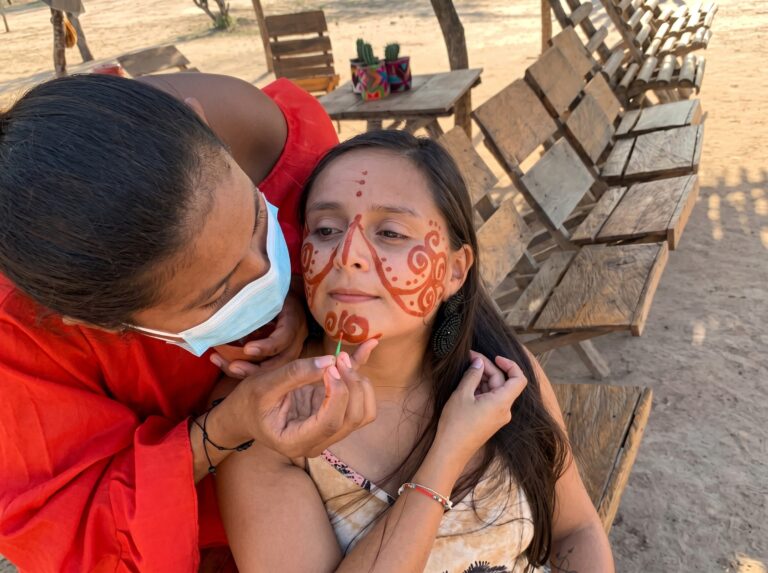 La Guajira
Planning a trip to La Guajira, Colombia? Discover how to get there, visit Punta Gallinas and Cabo de…
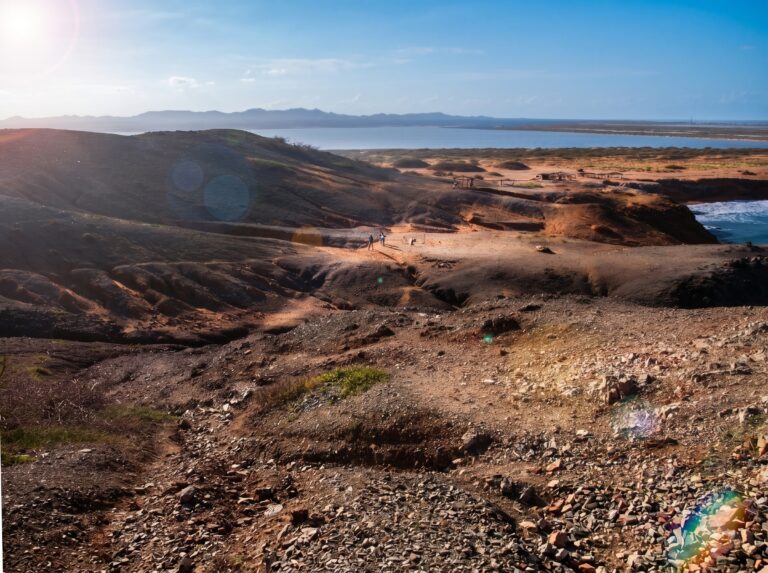 La Guajira
Located at the northern tip of the South American continent, La Guajira is a mix of wild landscapes, myths and…
 Communities
Every time I remember how I came to know La Guajira, the Colombian desert, I think that “My heart…”